
ALT TEXT: Three-lane swimlane grid with candlestick, notebook, bar chart and checkmark icons linked by blue arrows
A profitable backtest is evidence about the past. It is not a forecast, and the gap between those two things is where most new traders lose money. Testing a strategy on historical data still beats trading a hunch, provided you know which questions a replay session answers and which ones it quietly leaves open.
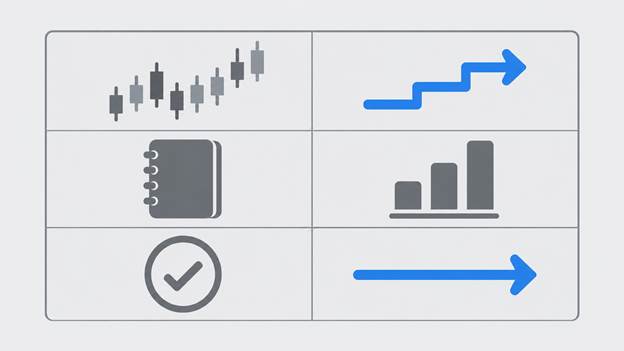
The method itself is simple enough. Browser tools such as FX Backtest replay historical candles bar by bar, so you place entries and exits without seeing what prints next, then review win rate, drawdown and expectancy at the end of the session. No install, no broker connection, no capital at risk.
Why screen time is the real product
Most discretionary strategies fail in live markets for reasons that have nothing to do with the rules. The trader hesitates on the entry, moves the stop, or doubles the size after two losses. Replay compresses the practice. A few evenings of bar-by-bar testing can put several hundred decisions behind you, which is the sort of repetition that normally takes a year of live trading to accumulate.
That is also the honest case for manual testing over fully automated runs. A computer can execute a rigid rule set faster than any human, but it cannot tell you whether you will actually follow your own plan at 8:30 a.m. when the payrolls number lands.
Hindsight is the easiest mistake to make
Every backtester eventually falls into the same traps. Testing one pair over one calm year and calling it an edge. Nudging the stop a few pips at a time until the equity curve looks pretty, which is curve fitting rather than research. Scrolling forward "just to check" before placing the entry.
Sample size is the blunt defence. Twenty trades will expose obvious execution problems, but a serious review usually wants 100 or more trades spread across trending, ranging and high-volatility conditions. A strategy that only works when the dollar is in a clean downtrend is a regime bet, not a system.
Costs decide whether an edge survives
Spread and commission are not rounding errors on a scalping strategy. A plan that nets half a pip per trade in a cost-free simulation is a losing plan in practice, and the difference only appears once you model the fees your own broker charges.
What the simulation assumes
What live trading adds
A fixed spread all day
Spreads that widen at rollover and around news
Fills at your stated price
Slippage on market and stop orders
Instant execution
Latency, requotes and platform outages
A disciplined operator
Hesitation, revenge trades and oversizing
Treat anything the simulator does not model as a margin you have to leave yourself, not as free profit.
Regulators treat simulated results as a special case
This scepticism is baked into US rules. The Commodity Futures Trading Commission requires that presentations of simulated or hypothetical performance carry a cautionary disclaimer, a requirement it reviewed and amended in its rulemaking on Regulation 4.41 to clarify where the disclaimer must appear. The point of the rule is that hypothetical records are prepared with the benefit of hindsight and involve no financial risk, so they tend to flatter.
Apply the same standard to your own numbers. A report card showing a 68% win rate across 140 replayed trades is a reason to keep testing, not a reason to raise your position size.
Turn the result into a plan
Once a strategy survives a decent sample, write down the rules before you trade them: the setup, the maximum risk per trade, the sessions you will trade, and the drawdown that makes you stop and review. Then forward test, either on demo or at a size small enough that the outcome does not matter, because forward testing is the only stage that includes your own behaviour.
Keep the context in view too. A rule built on tight ranges behaves differently once rate expectations shift, so check where the major pairs actually sit on a live currencies board before assuming last quarter's conditions still hold.
Backtesting is preparation, not proof. Trading foreign exchange carries a substantial risk of loss, and no amount of historical testing removes it.